
How to Prepare for a 409A Valuation: Documents and Timeline
 Jeet Chaudhary
on
Jeet Chaudhary
on

If you are running a startup or planning to issue stock options to employees, you will likely come across something called a 409A valuation.
While it may sound technical, it plays a very important role in your company’s financial and legal compliance.
A 409A valuation determines the fair market value (FMV) of your company’s common stock.
This value is used to set the strike price for stock options. Getting this right is essential because it helps you stay compliant with IRS regulations and avoid penalties.
If your valuation is incorrect or not properly supported, it could lead to serious tax consequences for both you and your employees. That is why the IRS has strict rules under Section 409A of the Internal Revenue Code.
The good news is that with the right preparation, the process can be smooth and efficient.
By understanding what documents you need and how the timeline works, you can avoid delays and ensure compliance.
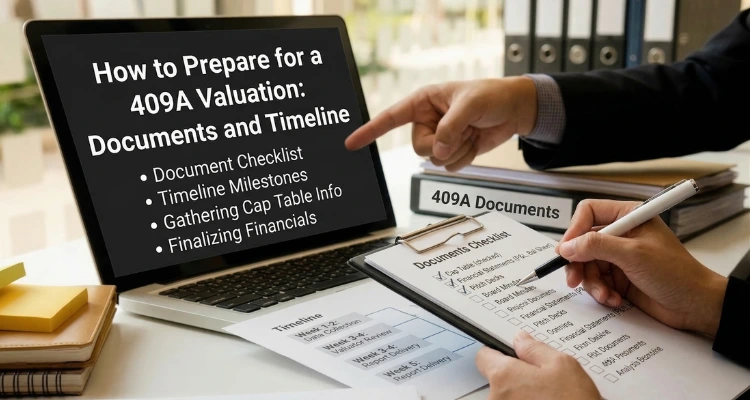
In this guide, you will learn how to prepare for a 409A valuation, what documents are required, and what timeline to expect.
What Is a 409A Valuation?
A 409A valuation is an independent appraisal of your company’s fair market value (FMV) of common stock.
It is required under Section 409A of the Internal Revenue Code, which governs how companies issue deferred compensation, including stock options.
The purpose of this valuation is to determine the strike price for stock options. The strike price must be equal to or higher than the fair market value at the time the options are granted.
To comply with IRS rules, the valuation must be conducted by a qualified and independent third party.
This helps ensure that the valuation is objective and defensible if reviewed by the IRS.
When Do You Need a 409A Valuation?
Knowing when you need a 409A valuation is just as important as understanding what it is.
Timing plays a key role in staying compliant with IRS rules and avoiding penalties.
In general, you should obtain a 409A valuation whenever there is a need to determine the fair market value of your company’s common stock, especially before issuing stock options.
Before Issuing Stock Options
You must have a valid 409A valuation before you grant stock options to employees, advisors, or consultants.
The strike price of those options must be set at or above the fair market value determined by the valuation. If you issue options without a proper valuation, you risk violating IRS regulations.
This can lead to serious tax consequences for your employees, including immediate taxation and additional penalties.
After Fundraising Events
A new 409A valuation is typically required after a fundraising round, such as a seed, Series A, or later-stage investment.
When you raise capital, your company’s valuation changes. Investors often purchase preferred stock at a higher valuation, which impacts the value of your common stock.
Because of this, your previous 409A valuation may no longer be accurate or valid.
Following Major Business Changes
You may also need a new 409A valuation after significant changes in your business.
Examples include:
- Rapid revenue growth or decline
- Launching a new product or entering a new market
- Mergers or acquisitions
- Major changes in financial projections
Any event that could affect your company’s value may require an updated valuation.
In addition, even without major changes, a 409A valuation is generally valid for 12 months. After that, you should obtain a new valuation to remain compliant.
Key Documents Required for a 409A Valuation
Preparing the right documents is one of the most important steps in the 409A valuation process.
The quality and accuracy of your documents directly impact how quickly and accurately your valuation can be completed.
If your documentation is incomplete or unclear, it can delay the process and affect the final valuation.
Below are the key documents you should prepare.
Company Overview Documents
Your valuation provider will need a clear understanding of your business.
This typically includes:
- A description of your company and what it does
- Your business model and revenue streams
- Organisational structure and leadership team
- Your capitalisation structure
These documents help the valuation firm understand how your business operates and how it generates value.
Financial Statements
Accurate financial data is essential for a reliable valuation.
You should provide:
- Historical financial statements
- Profit and loss statements
- Balance sheets
- Cash flow statements
These documents show your company’s financial performance and stability over time.
Financial Projections
In addition to historical data, your valuation provider will want to see your future expectations.
This includes:
- Revenue forecasts
- Expense projections
- Growth assumptions
- Budget plans
Financial projections help estimate your company’s future value and are a key part of most valuation methods.
Capitalisation Table (Cap Table)
Your cap table outlines the ownership structure of your company.
It should include:
- All shareholders and their ownership percentages
- Types of shares issued
- Stock options and warrants
- Convertible securities
A clear and updated cap table is critical for determining the value of common stock.
Recent Funding Information
If your company has raised capital, you will need to provide details about recent funding rounds.
This includes:
- Valuation from the latest round
- Investment terms and agreements
- Details about preferred shares
Funding data helps the valuation provider understand how investors value your company.
Intellectual Property and Assets
Your company’s assets can significantly impact its valuation.
You should include:
- Patents and trademarks
- Proprietary technology
- Key business assets
These assets often represent long-term value and competitive advantage.
Market and Industry Data
Finally, your valuation provider will consider your position in the market.
You may need to provide:
- Information about competitors
- Industry trends
- Market size and growth potential
This data helps compare your company to similar businesses and supports the valuation analysis.
Preparing these documents in advance can make the valuation process smoother and more efficient.
409A Valuation Timeline: Step-by-Step
Once your documents are ready, the next step is to understand how the 409A valuation process works.
Knowing the timeline helps you plan ahead and avoid delays, especially if you need the valuation before issuing stock options.
Here is a step-by-step breakdown of what you can expect.
Step 1: Gather Required Documents
The process begins with collecting all the necessary documents.
You should ensure that your:
- Financial statements are accurate and up to date
- Cap table is complete and current
- Business information is clearly documented
The more organised your documents are, the smoother the process will be. Missing or incomplete data can slow down the valuation.
Step 2: Select a Valuation Provider
Next, you will choose a qualified third-party valuation provider.
It is important to select a provider that:
- Has experience working with startups
- Understands IRS 409A requirements
- Provides defensible and compliant valuations
An independent valuation firm is essential if you want to qualify for safe harbor protection under IRS rules.
Step 3: Initial Assessment and Data Review
After selecting a provider, they will begin reviewing your documents.
During this stage:
- The provider analyses your financial data
- They may ask follow-up questions
- You may need to provide additional information
This step ensures that the valuation is based on accurate and complete data.
Step 4: Valuation Analysis
Once all information is collected, the provider performs the valuation analysis.
They may use different methods, such as:
- Market approach, comparing your company to similar businesses
- Income approach, based on projected cash flows
- Asset-based approach, focusing on company assets
The goal is to determine a fair and reasonable value for your common stock.
Step 5: Draft Report and Review
After the analysis, the provider prepares a draft valuation report.
At this stage:
- You review the draft
- Provide feedback if needed
- Clarify any assumptions or data points
This step allows you to ensure that all information is accurate before the final report is issued.
Step 6: Final Report Delivery
The final step is receiving your completed 409A valuation report.
This report includes:
- The final fair market value (FMV) of your common stock
- Details of the valuation methods used
- Supporting analysis and assumptions
Once you receive the final report, you can use it to issue stock options in compliance with IRS regulations.
How Long Does a 409A Valuation Take?
Understanding how long a 409A valuation takes can help you plan, especially if you need the valuation before issuing stock options or completing a funding round.
While timelines can vary, most valuations follow a fairly predictable process.
Typical Timeline
In most cases, a 409A valuation takes 2 to 4 weeks from start to finish.
Here is a general breakdown:
- 1 to 5 days to gather and submit documents
- 1 to 2 weeks for the valuation provider to review data and perform analysis
- A few days for draft review and final report delivery
If your documents are well-prepared and complete, the process can move faster. Some providers may even offer expedited timelines if needed.
Factors That Affect Timing
Several factors can influence how long your valuation takes.
1. Quality of your documentation: If your financials or cap table are incomplete or inconsistent, the provider may need additional time to request clarifications.
2. Complexity of your business: Startups with simple structures and limited history are usually quicker to evaluate. More complex companies with multiple funding rounds or international operations may take longer.
3. Availability of your team: Delays can happen if your team is slow to respond to questions or provide additional information.
4. Valuation provider workload: The timeline may also depend on how busy your valuation firm is at the time.
Planning and starting the process early can help you avoid delays and ensure that your valuation is ready when you need it.
Conclusion
Preparing for a 409A valuation is an important step if you want to issue stock options and stay compliant with IRS regulations.
While the process may seem complex at first, it becomes much more manageable when you understand what is required and plan ahead.
A properly prepared 409A valuation not only helps you avoid tax risks but also builds confidence with employees, investors, and stakeholders. It shows that your company is following best practices and maintaining transparency.
However, navigating the process on your own can be challenging, especially if you are dealing with complex financial data or multiple funding rounds.
Virtue CPAs specialises in helping startups and growing businesses with 409A valuations, tax compliance, and financial planning. Our experienced team can guide you through the process, ensure your documentation is accurate, and help you meet all IRS requirements.
If you want to streamline your 409A valuation and avoid costly mistakes, contact Virtue CPAs for a consultation.
Frequently Asked Questions

Jeet Chaudhary
Jeet Chaudhary serves as the Chief Operating Officer at Virtue Advisors, where he leads the firm’s Global Control Centre and oversees end-to-end operational excellence.